

We sit cross-legged in a circle, laughing as plates brimming with food are passed around. Chicken dressed with Aleppo peppers, charred aubergine smothered in garlic and adorned with precious pomegranate seeds, green mulukhia (a soup made from minced Jute mallow leaves – my all-time favourite) are just some of the offerings people bring to share. Golden saffron rice spills all over the carpet, but the hosts don’t mind; besides, Snoopy, the local dog, has just had her puppies and will gobble up whatever remains on the ground when we aren’t looking.
We’re not at a restaurant or a tavern but in a shipping container in a Greek refugee camp, made festive with Christmas lights left hanging from a few months ago. Spaces of suffering often turn into spaces of tremendous care. Everyone brings what they can: some baklava from a local shop, a bottle of wine poured out into tiny beakers for those who partake, a box of diapers for a new mum in need.
After years of being stuck here without knowing when limbo may end, people turn towards one another, recognising that we are stronger together. This is mutualism, creativity, and care in action, a reminder that all is not lost in this era of polycrisis – of one disaster after another, all of them worsened by the fact that they are linked. Many people are doing what they can to work towards a different world, an antidote to despair.
As techno-fascism takes hold, the polycrisis is increasingly dominated by surveillance. From robo-dogs at the US-Mexico border to facial recognition at sports stadiums across much of the world and algorithms deciding what we do and don’t see online, our lives are curated and sharpened by automation, digitisation and artificial intelligence. Technologies are used to oppress us rather than free us, as carla bergman and Nick Montgomery remind us in Joyful Militancy: Building Thriving Resistance in Toxic Times: “Through social media, smartphones, browsing histories, and credit cards, surveillance is ubiquitous, and increasingly participatory”.
It is much more difficult to challenge surveillance when it is presented as an inevitable part of our lives, yet people are still finding routes to do so. Over the course of my time as openDemocracy’s inaugural scholar-in-residence, I want to chart some of these ways that people are coming together to contest the challenging situation we are in.
Of course, people have long resorted to physically destroying surveillance cameras, either with brute force or spray paint. This is still true even now that the cameras are being flown overhead; take the videos of farmers in India going viral for throwing rocks with expert precision at government drones trying to quell their protests. But activists are now also turning surveillance back onto their oppressors, with environmental protesters using their own drones to monitor eco-crimes such as logging, and people in the occupied Palestinian city of Hebron filming Israeli police and settlers as a form of protection. There is creativity in resistance and survival.
And people are indeed getting creative. Make-up artists are designing anti-facial recognition make-up to bamboozle the cameras trying to scan our features, as has been covered by Vogue. Interestingly, it does not have to be a full face of makeup; even a modest application will confound the technologies. For those wishing for something a little bit more impenetrable, Polish designer Ewa Nowak has created the Incognito mask, which uses unique geometric shapes and reflective surfaces to deflect recognition software in security cameras.

For those looking to make use of what they already own, Wired magazine recommends wearing unremarkable dark clothing to “make yourself less memorable to both humans and machines”. But should you be in the market for a new piece of anti-surveillance clothing, how about a knitted sweater? Artist Ottilia Westerlund has developed a pattern of black and white shapes to confound biometric surveillance, and in an act of care, she’s made the pattern free to download. Sweaters as resistance?
So, how do we make things right?
Some groups are trying the co-optation route, using existing technologies to subvert and resist their oppressors.
Many use social media platforms such as TikTok to disperse information through quick explainer videos for know-your-rights campaigns or to share their journeys with the immediacy that can only come from a selfie-video filmed on a raft bobbing in the Mediterranean or from the treacherous crossing of the Darién Gap on the migration route between South and North America. Unfortunately, human smugglers are also using these platforms to sell their services, with business booming as many countries tighten their border controls. In Latin America, smugglers build their brands on promises of success laced with emojis and images of people climbing over walls and happy families waving American flags. All the while, people continue to die making these dangerous crossings.
Meanwhile, for those already in the US, various initiatives have sprung up to turn the eye towards immigration enforcement as the Trump administration continues its brutal crackdown on people on the move and migrant justice communities. In March last year, the TurnLeft Political Action Committee launched its Resist Map, an open-source project that it hopes will create a live nationwide registry of ICE activity by enabling communities to monitor and track ICE via text updates and a national map.
The search and rescue space is also responding with its own technologies. Sea-Watch, a German non-profit that patrols the Mediterranean to rescue people in distress whom the authorities have left to drown, has teamed up with SearchWing, which builds drones to help NGOs spot people in need of help. Search and rescuers have even set up their own satellites to safely share information, literally circumnavigating the telecommunications grid.
While these efforts are commendable, poet Audre Lorde reminds us that “the master’s tools will never dismantle the master’s house”. Current technologies are no panacea for freedom; they limit us to what already exists, rather than encouraging us to see what else is possible. But as Leanne Betasamosake Simpson, an author, musician, and academic from the Mississauga Nishnaabeg group of First Nation peoples in Canada, counters: “I am not so concerned with how we dismantle the master’s house, that is, which set of theories we used to critique colonialism; but I am very concerned with how we (re) build our own houses.”
Betasamosake Simpson’s approach, which she details in Dancing on Our Turtle’s Back: Stories of Nishnaabeg Re-Creation, Resurgence, and a New Emergence, champions the resurgence of what Italian philosopher Antonio Gramsci termed “subaltern knowledges”. These are the knowledge and perspectives of marginalised or oppressed groups, often those excluded from hegemonic systems of knowledge production.
Indigenous academics are introducing conceptions of AI that alter and enhance our understanding of reality, such as research by Megan Kelleher, from the Barada and Gabalbara people of Central Queensland in Australia, into how or whether Indigenous protocols can inform AI’s design. Elsewhere, Michael Running Wolf, a McGill University computer scientist from the Northern Cheyenne First Nation, created the Lakota AI Code Camp to train Indigenous youth in data science and AI. Running Wolf also champions Indigenous data sovereignty, similar to the goals of Canada’s First Nations Information Governance Center, which aims to ensure that data gathering is ethical and that First Nations communities are empowered to use their data for their needs, so that “every First Nation will achieve data sovereignty in alignment with its distinct world view… Our Data. Our Stories. Our Futures.”
Others are finding ways to fight back using the master’s ultimate tool: the law. Laws have long been used to oppress marginalised groups, concretising particular ideas about who belongs and who does not. Like a solid minority of the profession, I am a bit of a reluctant lawyer, having always struggled with the law being a hegemonic tool in and of itself, based on solidified categories such as ‘refugee’ vs ‘immigrant’ vs ‘expat’ – with little space left for the messiness of the human experience. And while international law can help maintain a common standard, states’ ratification of conventions often amounts to nothing more than performance on the global stage.
Despite these limitations, existing domestic laws can sometimes be stretched and expanded in novel ways, such as forcing states to rethink privacy legislation and the implications of growing surveillance on people’s data protection rights. International norms can be pushed to hold perpetrators of technological harm to account, such as a UN report from last year recognising that AI has played a major part in Israel’s targeting of civilians in the genocide in Gaza.
Tech bros often lament that regulation stifles innovation, but some innovation should be stifled – especially when it hurts real people. Yet when it comes to technology, regulation continues to lag behind – and is even being actively turned away from as private sector actors increase their influence in policymaking, as can be seen by X owner Elon Musk’s stint in the Oval Office and Facebook founder Mark Zuckerberg lobbying European politicians in Brussels. It’s no wonder that the EU’s long-awaited act to regulate AI does not go nearly far enough to protect people’s rights under the guise of protecting innovation, nor that the White House has signalled absolutely no appetite to regulate even the most harmful of technologies.
And while human rights are a very useful scaffolding to which we can pin responsibility of powerful actors, the human rights framework itself has been critiqued for being very European- and Western-centric. The laws prioritise individualism, excluding collective and community rights and often silencing histories and structural contexts outside of the so-called Global North. By looking beyond the individual and trying to expand our conception of community-based rights, the potential for a much broader framework emerges. What does ‘justice’ even mean when governments break their own laws before our very eyes, often through sweeping executive and emergency orders under the guise of protecting national security?
This is why a broader understanding of justice as social transformation can be very helpful. Transformative justice is a framework and an approach for responding to violence, harm, and abuse that highlights community-based solutions and addresses the root causes of injustice, aiming to prevent future harm and promote healing and accountability. For Mia Mingus, a writer, educator, and community organiser who focuses on issues of disability justice, it is “a way of ‘making things right’, getting in ‘right relation’ or creating justice together.”
In this conceptualisation, justice is not a static monolith but an active practice of care and of turning back towards one another that imagines alternatives to the way things currently are, towards a project of collective liberation.
As artist Monica Trinidad writes: “Everyday we face the myth that we are powerless against what is unfolding in front of us. And everyday we must remind ourselves – and each other – that our everyday actions, no matter how small, are impactful. Do not consent in advance. Do not feed the monster with your fear. And do everything you can to slow them down. Imagine us as individual grains of sand – what happens when millions and millions of grains of sand come together? They/we can do some REAL good damage.”
Towards collective liberation
Mutualism, or the recognition that mutual dependence is necessary to social well-being, lies at the heart of rethinking how we relate to one another carefully.
Mutual aid, explains Dean Spade, a lawyer, trans activist and professor at the Seattle University School of Law, in his book of the same name, is a system where individuals or groups cooperate and support each other without relying on formal institutions or charity; providing resources and services, such as food, shelter, and medical care, to meet each other’s needs, often in times of war, genocide, governmental breakdown, or other crises. It can also include financial solidarity and giving direct financial assistance to those in need, bypassing traditional bureaucratic systems, or food distribution through the organisation of food banks, community kitchens, or free meals to address food insecurity.
Mutual aid is built on the principles of cooperation, solidarity, and mutual understanding, emphasising that people can help each other and work together to address challenges. It is not charity, which often involves a hierarchical relationship between a giver and a receiver, but focuses instead on a voluntary exchange of resources and services among equals.
“When left alone, when left with one another, people turn to one another and use forms of mutual aid and support,” writes Marina Sitrin, a professor, lawyer and activist, in Everyday Revolutions. “The wake of the break is a beautiful opening up of possibility.”
Mutual aid networks often emerge from local communities, with individuals organising to meet the needs of their neighbours, and often aiming to address the root causes of problems and work towards transformative change. Ultimately, mutual aid reinforces the practice of support networks – informal webs of support for people facing specific challenges, such as homelessness or unemployment. It is also the practice of conviviality, a way of life promoting flourishing. Indeed, as carla bergman and Nick Montgomery argue, “in dramatic uprisings and slow shifts, people are reconnecting with their own powers and capacities to make, act, live, and fight together.” Our freedom is relational.
Mutual aid reminds us that we have deep responsibility towards one another, which “is not a burden but something that actually enhances our life experience,” writes Zainab Amadahy in Wielding the Force: The Science of Social Justice. “The word literally means ‘ability to respond’. In the relational framework, we might understand responsibility as the ability to respond appropriately – that is, for the common good. In this sense, responsibility is seen as preferable to individualism, which doesn’t really exist.”
This ability to respond is also grounded in the idea that there does not have to be repayment; that the act of mutualism and helping one another is a gift. As much as we should be wary of the technologised way our world is becoming, there are also creative ways that mutualism manifests through technology. On social media platforms such as BlueSky, which many have turned to as alternative to Musk’s X, people in Gaza are connecting with the outside world, sharing their experiences firsthand, with allies setting up fundraisers directly into people’s PayPal accounts.
When Robin Wall Kimmerer, a Potawatomi author, botanist and the founder and director of the Center for Native Peoples and the Environment, asked her students to reflect on what they think of as gifts, “many of these students’ examples come from a very different realm – the digital world”, she wrote in her book The Serviceberry. “They quickly cite access to open-source software and the existence of Wikipedia as manifestations of a gift economy, where knowledge is freely shared in an information commons. Over and over, they name TikTok and videos where ‘you can learn anything because someone has made a gift of their time and experience to share with anyone who wants it.’”
Kimmerer explores these digital gifts and finds mutual aid societies, local gift economies, alternative local currencies, money-free work exchanges, cooperative farms, and peer-to-peer learning are all grounded in “creativity and longing to propel change”.
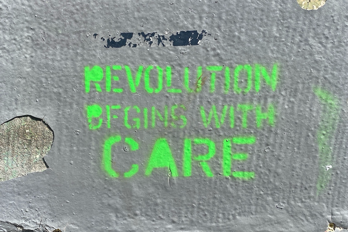
Mutual aid can look a myriad of different ways, but always at the centre lies the foundational idea that we are all interconnected. It is an opportunity to practice caring for one another without expectation of return, because at the end of it all, any lasting revolution must begin with care.


